
Introduction
Chemical plants leave you with no room for second-guessing when dealing with high-temperature pipelines, flare stacks and aging equipment. Traditional inspection methods rely on scaffold crews, rope access, non-destructive testing and safety officers entering storage tanks with inadequate ventilation. It may work, but it’s slow, risky and expensive. That’s why drone inspection for chemical plants in India is becoming the new normal, considering how much time and exposure you can avoid with the right tools.
SES Digital is leading in this space by bringing together drone pilots, data analysts, GIS specialists and certified inspectors under one roof and coordinating everything seamlessly. We are fitting the advanced tech with what’s really going on in Indian chemical plants. When we combine that with the experience we have with bulk chemical, specialty chemical and petrochemical plants, our drone inspection services give chemical plants fast, risk-free visibility into asset health without shutdown delays, access hazards or blind spots.
How Drones Save Workers from Hazardous Jobs
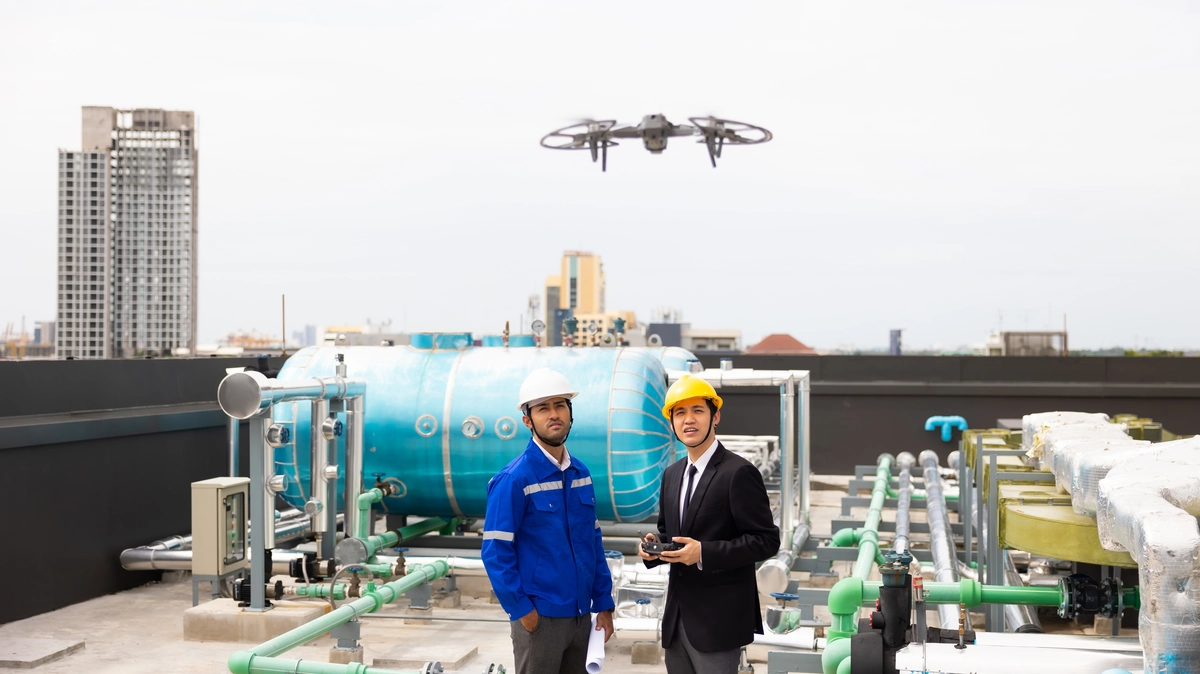
Entering a confined space or scaling a flare stack during shutdown season gets more uneasy with every cautious step. While some places are just tricky to get to, others are downright lethal. Our industry-grade drones in chemical plants are fitted with high-lumen lights, collision-avoidance sensors and HD stabilized cameras to handle those internal and high-altitude inspections that used to put technicians at physical risk.
Rather than sending a crew in with breathing apparatus and a rescue team on standby, a pilot controls the drone from a safe distance while the feed streams directly into SES Digital’s inspection console. Our drone inspection for chemical plants in India brings down the number of shutdown hours, permits you need and near-miss situations.
How Drone Inspection Services Deliver Faster, High-Quality Visual and Thermal Data
Chemical plant inspections rely on teeny tiny details, like leaks, subtle temperature variations, and early-stage corrosion that only shows up under the right lighting and imaging conditions. Our drones in chemical plants carry high-resolution RGB cameras, thermal infrared sensors and in some cases, LiDAR payloads. It all adds up to sharp, rock-steady videos and images of dents, slopes, edges and surface variations.
Hotspots on insulation, temperature gradients and early leak signatures on pipelines show up instantly, thanks to thermal sensors. It reduces inspection cycles from days to hours, especially if you add automated flight paths for regular surveys.
Key Applications of Drones in Chemical Plants
- Storage Tanks:
Our drones can check shell walls, weld seams, coating degradation and sludge patterns without atmospheric testing. The footage gives coating specialists all the confidence to make their calls.
- Flare Stacks:
Drone inspection for chemical plants provides engineers with a precise visual assessment of burner tips, risers and refractory surfaces.
- Pipelines & Racks:
High-res drones equipped with thermal cameras fly along overhead lines, keeping an eye out for corrosion, missing insulation cladding, deformities or steam leaks. Our software specialists analyze this combined data and make it into workable recommendations for civil, mechanical and maintenance teams.
Conclusion
With every inspection flight, you get a digitized record that you can refer back to during risk-based audits or efficiency-maximization exercises. This kind of data and measurement is what lets facilities extend equipment life, avoid the chaos of turnaround season, reduce high-risk interventions and build a more reliable industrial base for India. That’s why teaming up with SES Digital is much more than just getting quicker surveys or safer access. Drone inspection for chemical plants sets up a solid inspection foundation that you can rely on year after year, no matter how tough the process is or how tricky the regulatory environment gets.